
Weaving Villages in Luang Prabang, Laos: Two Main Villages

Srey Pov
Cambodia is my home, not simply another stop on an itinerary.
I was born in Phnom Penh, studied Hotel and Tourism Management, and have worked in tourism for over 10 years. I’ve also traveled extensively through Vietnam, Laos, Thailand, and Myanmar.
My work has included private journeys as well as a multi-country trip for a group of more than 50 travelers, which received a five-star review.
When I write about Cambodia and the wider region, I bring the view of someone who lives here and has spent years planning trips on the ground—not just repeating what appears in standard destination guides.

 Email me about your travel idea
In the more than 40 years after World War II, Laos' textile industry did not prosper but gradually disappeared. But in just a few years, they set off again and became the best place in the world to produce textile goods.
Laos is a country renowned for its tradition of weaving now and has the best weaving methods in the world. By the way, due to its multi-ethnic characteristics, the revolution of weaving has been driven by cultural exchanges between different ethnic groups.
Learn about the two main weaving villages in Luang Prabang to get deeper insights into the culture and traditions of Laos!
 Where Are the Weaving Villages Located in Luang Prabang?
Is It Worth to Visit the Weaving Villages? What to See?
Where Are the Weaving Villages Located in Luang Prabang?
Textiles are very important to the Lao people both for ceremonies and household uses, so weaving has been passed from generation to generation as an art and skill.
Over the years, Luang Prabang has become a hub for textiles, where tourists can get into the villages in there to see the life of the local ethnic people and how they weave and dye.
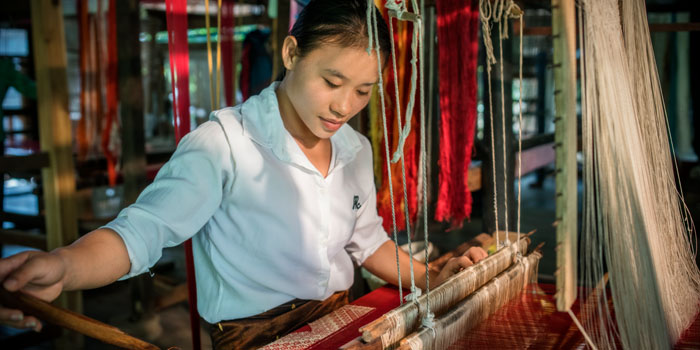 Textiles are very important to the Lao people
Many women work in textile workshops. On the one hand, it is to inherit tradition, and on the other hand, it is also to promote the development of the local economy. Their income is also determined by the quality of the things they make.
Visiting weaving villages in Luang Prabang is considered one of the fewest but fun things to do in Laos. There are actually two weaving villages in Luang Prabang that are very popular among tourists to Laos - the village of Ban Phanom and the village of Ban Xang Khong. Now let's briefly understand the basic information of these two villages:
Ban Phanom
The former village is a 10-minute drive outside the city of Luang Prabang. It is small but has existed for many years because it can make high-quality manufacture of woven goods and get a good price on the night market.
Nearly all families here possess one or more weaving looms and the methods, techniques, and patterns they employ are the same as in old times. So here you can observe very ancient techniques, such as using a bare foot to alternately step on a wooden stick on the ground to make the machine move.
Ban Xang Khong
The latter village is about 5 miles east of the center of Luang Prabang. It has specialized in manufacturing products made from silk and Saa Paper. There are some private houses operated by local people who still employ the traditional techniques of weaving.
Tourists can pay visits to these homes where they can see how local people weaving and dyeing. Except for silk weaving, there is a small papermaking facility that produces hand-made paper and turns them into carry bags and gift boxes.
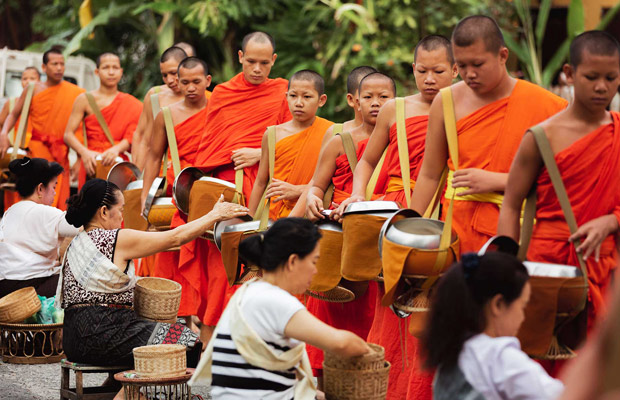

Is It Worth to Visit the Weaving Villages? What to See?
If you are interested in ethnic minority culture or art, visiting weaving villages in Luang Prabang is very meaningful as a trip of lifetime in Laos. Follow us, here you can not only visit the weaving village but also participate in local weaving classes to learn how to dye and weave.
It will add icing on the cake to your trip to Laos. Laos is a multi-ethnic country with rich and diverse cultural exchanges among ethnic groups. Among them, weaving is no exception. The revolution of weaving gradually developed due to the communication between different ethnic groups.
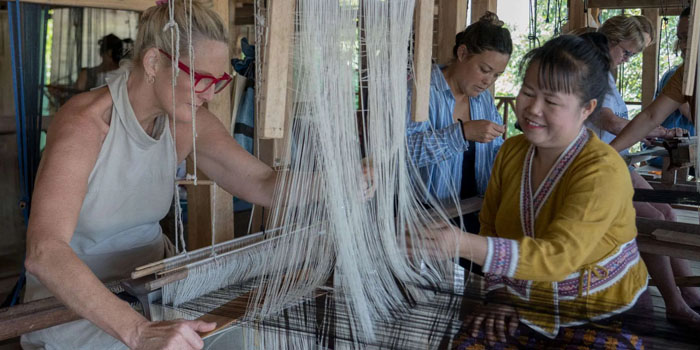 Learn weave in Laos Luang Prabang weaving village
In addition to visiting the city's beautiful scenery and the magnificent temples, whether in cities such as Luang Prabang, Vientiane, or Vang Vieng, such an in-depth exploration of cultural traditions will be a very unique experience!
There, you will visit workshops for craftsmen. You will see textile machines, cotton to be processed, and waiting to be dyed or naturally colored cotton threads, as well as various types of fabrics that are partially or have already been completed.
On a sunny afternoon, you walk into the weaving workshop, watching the scene of young craftsmen working hard, and then looking at the beautiful patterns on the fabric table, feeling that the traditional practices of traditional clothing will be optimistically spread again.
Perhaps this is the significance of visiting, apart from locals, to allow more tourists from all over the world like you to learn about Laotian traditions and promote the integration of world cultures!

What Can I Shop from the Weaving Villages?
Here you can buy many useful woven goods as a gift for yourself, your family, or friends. For example, you can buy sorts of scarves, dresses, belts, etc. that are made from pure silk or cotton.
Some weaving villages in Luang Prabang have their own shopping center in the town. You can find other types of products there, such as hanging decorations, cloth bags, clothes, pillowcases, tapestries, etc. You can also buy Saa Paper handmade products, like paintings, notebooks, lanterns, etc.
It is possible to negotiate appropriately. Most of the products are very affordable from $5 to $20. However, some large handicrafts may be more expensive.
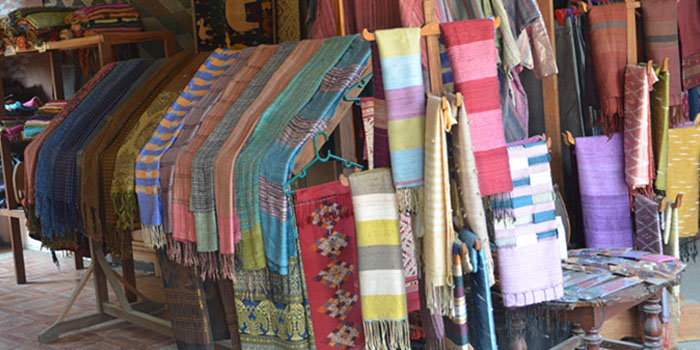 Laos Luang Prabang woven goods
Conclusion
Apart from the two main weaving villages in Luang Prabang mentioned earlier, there are many other weaving villages waiting for you to explore, such as Ban Xiengkhong and Ban Xienglek. Contact us for more information about Laos tour. Except for the richness of its traditions and culture, many other famous attractions are waiting for you to explore!
Srey Pov
Cambodia is my home, not simply another stop on an itinerary.
I was born in Phnom Penh, studied Hotel and Tourism Management, and have worked in tourism for over 10 years. I’ve also traveled extensively through Vietnam, Laos, Thailand, and Myanmar.
My work has included private journeys as well as a multi-country trip for a group of more than 50 travelers, which received a five-star review.
When I write about Cambodia and the wider region, I bring the view of someone who lives here and has spent years planning trips on the ground—not just repeating what appears in standard destination guides.
Email me about your travel idea