

Best Time to Visit Halong Bay: Ultimate Guide on Halong Bay Weather and Best Months for Cruises

Ivy
I’m Ivy. Over the past 10 years, I’ve planned private trips for more than 500 travelers, and those journeys have received 100% positive feedback.
In 2018, I traveled solo across Indochina. Since then, I’ve looked at routes differently. Some need another night. Some transfers take too much time for too little reward. And sometimes, an itinerary simply has too much packed into it.
That is the kind of detail I focus on when I write—how long to stay, which route makes sense, and what is actually worth including.

 Email me about your travel idea
The best time to visit Halong Bay is March through April and September through November, with October sitting at the top of the entire calendar. These windows give you calm seas, strong visibility across the karsts, and comfortable temperatures for time spent on deck.
Outside these windows, the bay is still worth visiting. Summer offers lush green scenery at lower prices, while winter trades panoramic views for a quieter, moodier cruise atmosphere that suits certain travelers well.
Cruising is the highlight of any trip, and calm seas make it far more relaxing. Knowing when to go helps you avoid crowded boats and enjoy outdoor decks and sunrise views.
|
Season |
Months |
Sea Conditions |
Visibility |
Temperature |
Best For |
|
Spring |
Mar–May |
Calm |
Good–Excellent |
20–30°C |
Cruises, kayaking, photos |
|
Summer |
Jun–Aug |
Rough at times |
Fair |
28–35°C |
Budget travel, lush scenery |
|
Autumn |
Sep–Nov |
Calm |
Excellent |
20–30°C |
Cruises, photography, comfort |
|
Winter |
Dec–Feb |
Moderate |
Low–Fair |
15–22°C |
Quiet cruises, budget deals |
 Halong Bay Weather Overview: Seasons, Sea Conditions, and Visibility
Halong Bay in Spring (Mar–May): One of the Best Times to Visit Halong Bay
Halong Bay in Autumn (Sep–Nov): A Sweet Spot for Calm Seas and Better Light
Halong Bay in Winter (Dec–Feb): Cooler Days with a Quiet Cruise Mood
Halong Bay in Summer (Jun–Aug): Hot, Wet Days and Rougher Seas
Cheapest Time to Visit Halong Bay: Cruise Deals and Booking Timing
Halong Bay Weather by Month: A Month-by-Month Planning Guide
When to Avoid: Public Holidays and Peak Travel Weeks
If Your Halong Bay Cruise Is Cancelled: What Happens and Backup Plans
How to Check the Halong Bay Forecast Before You Go
Halong Bay Weather Overview: Seasons, Sea Conditions, and Visibility
Halong Bay follows a four-season pattern. This sets it apart from Hoi An and Ho Chi Minh City, both of which operate on a simpler two-season tropical rhythm. Northern Vietnam experiences genuine seasonal shifts: a cool winter, a warm spring, a hot and wet summer, and a comfortable autumn.
This is also why many travelers planning broader Vietnam tours often include Halong Bay in the north during the cooler, clearer months, especially when combining it with Hanoi and other northern destinations.
Winter temperatures can drop to 15°C on the water. That's a significant contrast from Saigon's year-round heat. Travelers planning a Halong Bay cruise in January or February should pack accordingly.
Summer heat can reach 35°C, with humidity climbing alongside it. The difference from Saigon is that Halong Bay's summer also carries typhoon risk, which affects cruise scheduling in ways city-based travel doesn't.
 Halong Bay changes noticeably across the year, from cool winter days to warm and humid summer weather.
Sea Conditions: What They Mean for Your Cruise
Sea state matters more on a Halong Bay cruise than most travelers realize until they're on the water. The bay is partially sheltered by its island geography, which dampens the worst of open-ocean swells.
But strong winds during summer storms and winter cold fronts still create choppy conditions that affect open-deck time, kayaking, and tender boat transfers to caves and beaches.
Calm seas run most reliably from March through May and from September through November. These are the windows when cruise operators report the fewest weather-related itinerary adjustments.
From June through August, conditions are generally fine on most days but deteriorate more quickly and unpredictably during storm systems. Operators monitor forecasts closely and adjust routes when needed.
December through February brings a different challenge. Cold fronts moving down from China create short, choppy waves even without rain. Combined with fog, these months require the most flexible expectations of any season.
 Halong Bay’s island geography helps shelter the water from stronger open-sea swells.
Visibility and the Limestone Karsts
Spring and autumn deliver the clearest conditions. Autumn light in particular (from late September through November) has a quality that professional photographers specifically target for Halong Bay shoots.
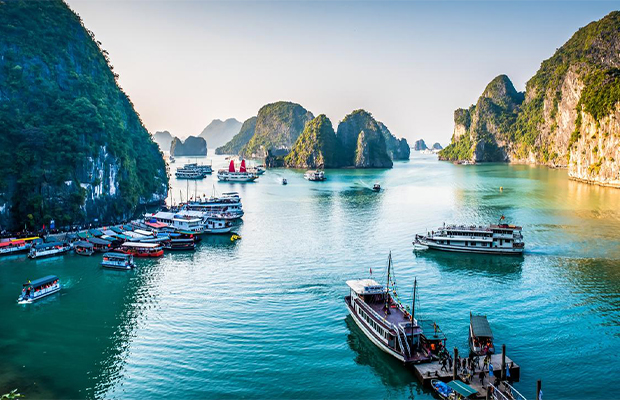
Visibility is what makes or breaks the Halong Bay experience photographically. Clear skies and calm mornings reveal the full scale of the karst landscape, with hundreds of islands stretching into the distance. Early mist lifts from the peaks, and reflections shimmer on the still water.
Fog is the main visibility challenge. It's most prevalent from December through February and can be dense enough to reduce visibility to a few hundred meters.
Some travelers find the foggy atmosphere of Halong Bay beautiful. Others feel robbed of the panoramic views they came for. Both reactions are legitimate, but knowing the fog risk before booking avoids disappointment.
 March to May and September to November usually bring calmer sea conditions in Halong Bay.
Typhoon Season: What the Risk Actually Looks Like
Typhoons affecting Halong Bay occur primarily between July and September. Direct hits are not an annual event, but tropical storms that push rough conditions into the Gulf happen most summers.
When serious weather approaches, the Quang Ninh provincial authorities suspend cruise operations. This is non-negotiable. No reputable operator departs against an official suspension order.
The practical risk for travelers isn't being caught in a typhoon at sea. It's arriving for a booked cruise, only to find it's been cancelled due to a weather suspension. The best time to travel to Halong Bay, specifically to avoid this scenario, is outside the June–September window.
 July to September is the main period when storm systems can affect Halong Bay cruises.
Halong Bay in Spring (Mar–May): One of the Best Times to Visit Halong Bay
Spring is when Halong Bay transitions from winter's gray stillness into something truly vibrant. The karst landscape appears its most striking in March and April. Clear air, calm waters, and the quality of morning light make these months unlike any other season on the bay.
Cruise itineraries run most smoothly in spring. Operators rarely adjust routes for weather, and activity schedules run on time. The overall experience feels effortless in a way that summer and winter months don't, especially on well-planned cruise itineraries in Halong Bay.
Spring suits first-time visitors most naturally. Reliable conditions and full activity availability remove most planning anxiety. The one window worth avoiding is the late April public holiday cluster, unless reservations are secured at least 8 weeks in advance.
Swimming conditions improve progressively through the season. Water temperature reaches a comfortable 22 to 24°C by April. Afternoon stops off the boat become genuinely enjoyable rather than just scenic. This is also when many travelers start looking into practical tips before booking a Halong Bay cruise.
 Spring mornings in Halong Bay are calm, bright, and especially beautiful for cruising.
Halong Bay in Autumn (Sep–Nov): A Sweet Spot for Calm Seas and Better Light
Autumn is the season when travelers often return to Halong Bay. Typhoon risk has passed by October, and humidity decreases from its peak in August. The light on the limestone karsts becomes warm and low-angle, making the scenery look quite different from spring or summer.
The water in early autumn retains the warmth from summer. Swimming conditions in September and early October are some of the best of the year. Kayaking through cave passages and hidden lagoons flows smoothly throughout the entire autumn season.
By November, the bay grows quieter. Visitor numbers thin, anchorage spots open up, and the pace of a cruise slows into something more spacious. Travelers who find March and October too busy often specifically target November for this reason, especially on some of the more highly rated Halong Bay cruise options.
Autumn rewards travelers who value evening water experiences. Squid fishing runs on calm, clear nights from October onwards. Sunset deck time carries a warmth and color quality that spring sunsets don't match.
 Autumn brings softer light and calmer views across Halong Bay.
Halong Bay in Winter (Dec–Feb): Cooler Days with a Quiet Cruise Mood
Winter transforms Halong Bay cruises entirely. It stops being just a visual spectacle of clear skies and panoramic views. Instead, it becomes something quieter, more atmospheric, and truly unique in its own way.
FoSitting over the bay on a January morning offers a very different experience from October's clear views. Limestone peaks fade in and out through white mist. Travelers who understand this tend to find winter one of the most unforgettable times to visit.
Temperatures over open water at nightfall are significantly lower than those during the day. A proper warm layer is essential from December through February. Activity schedules shift later as fog lifts, influencing when outdoor activities are possible each morning. In this season, it can also make sense to think more carefully about where to stay in Halong Bay before or after the cruise.
Value is winter's most practical advantage. Outside Tet week, January and February offer the lowest cruise prices across all boat categories. Boats are less crowded, anchorage spots feel more open, and crew interactions seem more personal when passenger numbers are lower. For travelers looking at the bigger picture, this is also a useful season to compare a Halong Bay trip with other forms of Vietnam cruise travel.
 Winter in Halong Bay can feel quiet, misty, and very atmospheric.
Halong Bay in Summer (Jun–Aug): Hot, Wet Days and Rougher Seas
Summer is the most demanding season for a Halong Bay cruise. Heat and humidity make midday hours on deck quite uncomfortable. Typhoon risk from July through August adds an unpredictability that no other season has.
The bay in summer has a unique visual character that other seasons lack. Islands turn intensely green after weeks of rain. Limestone cliffs shine after heavy downpours. Travelers who visit during a clear summer often find the scenery more dramatic and vivid than in spring or fall. It can also appeal to travelers who like broader water-based experiences, including a Vietnam boat tour style of trip rather than a classic one-season sightseeing journey.
Afternoon rain arrives most days between June and August. Morning activity windows from 6:00 am to 10:00 am are the most reliable part of any summer day. Keeping afternoon plans flexible rather than fixed makes the difference between a frustrating day and a perfectly functional one.
Budget travelers get the strongest case for summer. Cruise prices sit below spring and autumn peak rates, and availability on quality boats is easier to secure. A summer cruise booked with the right operator and a flexible attitude consistently delivers a worthwhile experience, especially for travelers already moving north from the south and planning a trip to Halong Bay from Saigon.
 Summer in Halong Bay is greener, hotter, and more changeable than other seasons.
Cheapest Time to Visit Halong Bay: Cruise Deals and Booking Timing
The cheapest time to visit Halong Bay spans two windows. January and February (outside of Tet week) offer the lowest overnight cruise rates of the year. November and early December provide a second value window with significantly better weather than January.
The summer months from June through August fall in the middle. Prices are lower than during spring and autumn peaks, but not as low as during winter. The value calculation depends on your tolerance for heat and weather unpredictability.
|
Period |
Price Level |
Weather Quality |
Value Rating |
|
Jan–Feb (ex-Tet) |
Very low |
Poor–Fair |
High for budget travelers |
|
Mar–Apr |
High |
Excellent |
Low–Medium |
|
May |
Medium |
Good |
Good |
|
Jun–Aug |
Medium |
Fair–Mixed |
Medium |
|
Sep–Oct |
Medium–High |
Excellent |
Medium |
|
Nov–early Dec |
Medium |
Very good |
High |
|
Late Dec |
High |
Fair |
Low |
|
Tet week |
Very high |
Poor–Fair |
Very low |
Booking Timing: How Far Ahead to Reserve
For March, April, and October (the three peak-quality months), book four to eight weeks ahead for mid-range cruises and ten to twelve weeks ahead for premium boats. Quality vessels in these months fill up genuinely fast.
For November, May, and early December, two to four weeks ahead is usually sufficient for most cruise categories. Last-minute deals occasionally appear, but reliable availability requires more lead time than that.
For January, February outside Tet, and June through August, last-minute booking is feasible on most boats. The exception is Tet week in February, which requires booking two to three months ahead, regardless of weather conditions.
For travelers comparing value, it helps to look at a few of the better-known Halong Bay cruises rather than judging only by price.
What "Cruise Deal" Actually Means in Halong Bay
Discounts on Halong Bay cruises appear most frequently in January, February, and the summer months. Operators offer reduced rates to fill boats during low-demand periods.
The important nuance is that a discounted rate on a poor-quality boat is never a good deal, regardless of season. A mid-range boat in January at 40% off still delivers a better experience than a budget boat in October at full price. Focus on operator reputation and boat quality first, then apply seasonal pricing as a secondary filter.
 Low-season cruises in Halong Bay often feel quieter and more spacious.
Halong Bay Weather by Month: A Month-by-Month Planning Guide
This month-by-month view works best when travelers treat it as a planning tool rather than just a weather table. It helps you match the right month to the right cruise style, activity focus, and tolerance for crowds or risk. It also becomes more useful when read alongside the main things to do in Halong Bay.
|
Month |
Weather Feel |
Sea Conditions |
Travel Note |
|
Jan |
Cold, foggy, quiet |
Moderate to choppy |
Low prices, but wide views are often limited |
|
Feb |
Cool and slowly improving |
Moderate |
Good value outside Tet, afternoons are better |
|
Mar |
Clear, fresh, comfortable |
Excellent |
One of the best months overall |
|
Apr |
Warm, bright, scenic |
Excellent |
Great for cruises and swimming, but busier |
|
May |
Hotter with some showers |
Good |
Good balance of weather and fewer crowds |
|
Jun |
Hot and humid |
Good to mixed |
Best for early starts and flexible plans |
|
Jul |
Very hot and unstable |
Mixed to rough |
Highest typhoon and cancellation riskw |
|
Aug |
Hot, busy, changeable |
Mixed to rough |
Similar to July, with more domestic crowds |
|
Sep |
Improving later in the month |
Mixed early, calmer late |
Better value, especially in late September |
|
Oct |
Warm, calm, and clear |
Excellent |
The strongest all-around month |
|
Nov |
Comfortable and quieter |
Excellent |
Great for a relaxed cruise |
|
Dec |
Cool, calmer early, colder late |
Good to moderate |
Early December is better than late December |
January
Daytime Temperature: 15–19°C
Sea Conditions: Moderate–Choppy
Crowds: Low
Value: Excellent
Best Activity Window: 11:00 am–3:00 pm on clear days
January is the coldest and foggiest month on the Halong Bay calendar. Fog is dense and persistent through most mornings. It typically lifts between 10:00 am and 11:30 am on clearer days, but on foggy days it can stay through the afternoon. Panoramic karst views are genuinely unreliable this month.
Morning kayaking slots (usually scheduled by cruise operators between 8:00 am and 10:00 am) often run in low visibility conditions in January. Cave visits work normally since visibility inside caves doesn't depend on the weather.
Local tip:Request a 6:00 am wake-up call from your operator. Don't wait for the fog to clear before grabbing your camera. Karst faces emerging from white mist at dawn make for extraordinary close-up shots. The panoramic views can wait. That foggy hour cannot.
February
Daytime Temperature: 15–22°C
Sea Conditions: Moderate
Crowds: Low (very high during Tet)
Value: Excellent (very low during Tet)
Best Activity Window: 1:00 pm–4:00 pm
February splits into two distinct halves. The first half mirrors January — cold, foggy, and quiet. The second half begins warming slowly. Tet falls in late January or February most years. During Tet, boats fill, and prices spike sharply.
Outside Tet, February mornings start around 7:00 am with fog that clears between 10:00 am and noon on reasonable days. Afternoon conditions from 1:00 pm to 4:00 pm are the most reliable outdoor window of any February day.
Local tip: If Tet falls during your cruise, confirm the boat's position for fireworks by 11:30 pm the day before. Most operators do this automatically. Confirming early gets you a better deck spot before other passengers claim it.
March
Daytime Temperature: 18–24°C
Sea Conditions: Excellent
Crowds: Medium
Value: Medium
Best Activity Window: 7:30 am–11:30 am and 4:00 pm–6:30 pm
March is the best time to visit Halong Bay, Vietnam, in earnest. Morning kayaking from 7:30 am to 9:30 am catches the mist-to-clarity transition at its most photogenic. Sunrise on deck is worth the 5:45 am alarm — light hits the karst peaks from the east, and the water sits completely still at that hour.
Cave visits are best scheduled between 9:00 am and 11:00 am, before the afternoon tour groups arrive in larger numbers. Sung Sot Cave and Thien Cung Cave become busier after 11:00 am as day cruise boats arrive from Tuan Chau port.
Local tip: Set your alarm for 5:45 am. Get to the bow before anyone else does. The eastern light hitting the karst peaks at sunrise, with the water below completely still, is the defining visual of a Halong Bay cruise. Missing it to sleep in is a genuine regret.
 March is one of the most rewarding months for sunrise views in Halong Bay.
April
Daytime Temperature: 22–28°C
Sea Conditions: Excellent
Crowds: High (peak late April)
Value: Low–Medium
Best Activity Window: 7:00 am–11:00 am and 4:00 pm–7:00 pm
April is warm and busy, but still great. The mornings in April are the best part of the day — kayaking from 7:00 am to 9:30 am and sunrise deck time from 5:30 am to 6:30 am both go very well.
Afternoon swimming off the boat suits April well — water temperature around 22–24°C feels refreshing without being cold. Most cruise operators schedule swimming stops between 2:00 pm and 4:00 pm.
Local tip: Arrive at Sung Sot or Thien Cung Cave by 9:00 am sharp. Day cruise boats from Tuan Chau port start arriving after 11:00 am. The difference in crowd levels between 9:00 am and 11:30 am is significant enough to change the experience completely.
May
Daytime Temperature: 26–32°C
Sea Conditions: Good
Crowds: Medium
Value: Good
Best Activity Window: 6:30 am–11:00 am
May pushes toward 28–32°C by midday. Rain typically arrives as afternoon showers between 2:00 pm and 4:30 pm. Mornings from 6:30 am to 11:00 am remain reliable for outdoor activities.
Post-holiday pricing from the April peak eases back in mid-May. Boats are less full, anchorage spots are less congested, and the overall experience carries more breathing room than late April.
Local tip: Ask operators directly about last-minute availability in mid-May. Post-holiday pricing drops noticeably after the April 30th surge clears. Deals exist, but operators rarely advertise them. A direct message or call gets a more honest answer than a booking platform does.
June
Daytime Temperature: 28–33°C
Sea Conditions: Good–Mixed
Crowds: Medium
Value: Good
Best Activity Window: 6:30 am–10:30 am and 6:00 pm–9:00 pm
June heat peaks between 11:00 am and 3:00 pm when deck time becomes uncomfortable. Schedule all active outdoor experiences — kayaking, swimming, cave visits — before 10:30 am without exception.
Rain arrives most afternoons between 2:00 pm and 5:00 pm. Evenings from 6:00 pm onwards are frequently clear, making sunset from the deck and squid fishing after 8:00 pm reliable June highlights.
Local tip: Don't skip squid fishing just because it's a hot day. June evenings are reliably clear after 6:00 pm. The activity runs after 8:00 pm on calm water. It consistently surprises travelers who almost didn't bother signing up.
July
Daytime Temperature: 30–35°C
Sea Conditions: Mixed–Rough
Crowds: Medium
Value: Good
Best Activity Window: 6:00 am–9:30 am
July is the most weather-volatile month. Typhoon systems can disrupt cruise operations with 24–48 hours' notice. The cancellation risk is the highest of the year. When provincial authorities issue a suspension order, departures stop regardless of operator or booking status.
Schedule kayaking and swimming before 9:30 am. Cave visits run from 8:00 am to 10:00 am, before the afternoon heat makes walking between sites exhausting. Keep afternoon plans completely flexible.
Local tip: Message your operator exactly 2 days before departure at 9:00 am. Ask directly about the forecast and their contingency plan. A good operator replies within two hours with clear options. A vague or slow response tells you something important about how they handle cancellations.
August
Daytime Temperature: 29–34°C
Sea Conditions: Mixed–Rough
Crowds: Medium–High
Value: Medium
Best Activity Window: 6:30 am–9:30 am
August closely resembles July. Domestic tourism hits its peak as Vietnamese school holidays draw families to the bay in large numbers. Boats are more crowded than in July, morning slots fill up quickly, and well-known anchorage spots feel noticeably more crowded.
Early morning kayaking from 6:30 am to 8:30 am is the most comfortable time to enjoy the outdoors. By 9:30 am, heat and humidity combine to make sustained physical activity unpleasant. Afternoon rain arrives most days between 1:30 pm and 4:30 pm.
Local tip: Book the earliest kayaking slot you can. 6:30 am is significantly cooler than 7:30 am in August. The water is also calmer. That one-hour difference turns kayaking from a chore into an enjoyable experience.
September
Daytime Temperature: 27–31°C (early) / 25–29°C (late)
Sea Conditions: Mixed (early) / Calm (late)
Crowds: Low
Value: Excellent
Best Activity Window: 6:30 am–10:00 am (early) / 6:30 am–10:30 am and 3:30 pm–5:30 pm (late)
Early September carries August's character — heavy humidity, afternoon rain between 2:00 pm and 5:00 pm, and residual typhoon risk through mid-month. From September 20th onwards, conditions shift measurably.
Late September mornings from 6:30 am to 10:30 am are ideal. Humidity decreases, the air feels cleaner, and the quality of light across the bay begins its autumn improvement. Water temperature remains warm from summer—around 26–28°C—making late afternoon swimming from 3:30 pm to 5:00 pm truly enjoyable.
Local tip: If your dates fall after September 20th, ask specifically about Lan Ha Bay routing. Conditions there in late September are excellent. Boat traffic is a fraction of what the main Halong Bay zones see. Most operators offer this routing but may not suggest it unless prompted.
October
Daytime Temperature: 22–28°C
Sea Conditions: Excellent
Crowds: Medium
Value: Medium
Best Activity Window: 7:00 am–9:30 am and 3:00 pm–6:00 pm
October is the strongest single month for Halong Bay cruises. Sunrise at approximately 5:50 am to 6:10 am throughout the month catches the karst peaks in warm, low-angle light that photographers specifically target.
Morning kayaking from 7:00 am to 9:30 am runs in ideal conditions. Cave visits from 9:00 am to 11:00 am avoid the midday heat entirely. Afternoon deck time from 3:00 pm to 6:00 pm is excellent for photography as the sun drops toward the western karsts.
Squid fishing after 8:30 pm on calm October evenings is one of the bay's genuinely memorable experiences. The water is clear enough that squid gather visibly around the boat lights.
Local tip: Bring a dedicated camera for the 5:50 am sunrise. October morning light on the karsts is the strongest all year. Phone cameras do okay, but a good camera captures it beautifully. The extra weight in your bag is worth it this month.
November
Daytime Temperature: 18–24°C
Sea Conditions: Excellent
Best Activity Window: 7:00 am –10:30 am and 2:30 pm–5:30 pm
Crowds: Low
Value: Good
November continues October's calm seas through most of the month. Temperatures ease to 18–24°C — comfortable during the day but requiring a light jacket after 7:00 pm on deck.
Morning activity windows from 7:00 am to 10:30 am remain excellent. Fog begins reappearing occasionally from mid-November but is lighter and clears faster than the dense January version — usually lifting by 8:30 am to 9:00 am.
Local tip: Carry a light jacket in your daypack each day, not your cabin bag. November evenings cool down faster than daytime temperatures suggest. By 7:00 pm, on open water with wind, the temperature drops unexpectedly, catching most travelers off guard.
December
Daytime Temperature: 17–22°C (early) / 15–20°C (late)
Sea Conditions: Good (early) / Moderate (late)
Crowds: Medium (early) / High (late)
Value: Good (early) / Low (late)
Best Activity Window: 8:00 am–11:30 am (early) / 9:00 am–12:00 pm (late)
December splits clearly between early and late months. Early December, from the 1st through approximately the 15th, continues November's comfortable conditions — temperatures around 17–22°C, low fog risk, and calm seas.
From December 16th onwards, Christmas and New Year demand pushes prices sharply upward. Cold fronts arrive more frequently in late December, creating choppy periods of 1 to 2 days between clearer windows.
Local tip: Plan to visit during the first two weeks of December if your dates are flexible. The weather then resembles late December. Prices are lower, and Anchorage spots are less crowded. The holiday crowd starts arriving from December 20th, and the overall experience changes significantly after that date.
When to Avoid: Public Holidays and Peak Travel Weeks
Certain weeks on the Vietnamese holiday calendar boost demand for Halong Bay cruises (and prices) significantly above normal. Knowing these dates in advance helps avoid the disappointment of your preferred boat being fully booked or costing more than your budget allows.
Vietnam New Year (Tet) is the biggest disruptor. The three to five days surrounding the Vietnamese New Year (which falls in late January or February, depending on the lunar calendar) fill up quality cruise boats. Prices during Tet week are 30–60% higher than standard rates on comparable boats. Book ten to twelve weeks in advance if your dates overlap.
The holiday period from April 30th to May 1st, which combines Reunification Day and International Labour Day, results in a four to five-day increase in domestic travel. Departures from April 28th through May 3rd are most affected. Both mid-April and mid-May offer similar weather conditions with much less booking pressure.
The September 2nd National Day holiday causes a shorter but meaningful spike in demand. Cruises departing from September 1st through September 4th sell out faster than those on nearby dates. Two to three weeks of additional lead time should be enough to manage this window.
|
Holiday |
Dates |
Booking Lead Time Needed |
Price Impact |
|
Tet (Vietnamese New Year) |
Late Jan or Feb (lunar) |
10–12 weeks |
High |
|
Reunification Day + Labour Day |
Apr 28–May 3 |
8–10 weeks |
Medium–High |
|
National Day |
Sep 1–4 |
4–6 weeks |
Medium |
|
Christmas + New Year |
Dec 22–Jan 2 |
8–10 weeks |
Medium–High |
International Peak Periods Worth Noting
Western holiday periods (particularly Christmas through New Year from December 22nd to January 2nd) bring a significant increase in international bookings for premium cruise boats. Three-night and two-night itineraries on well-reviewed vessels fill up fast from early October onwards.
Chinese New Year, which falls on the same date as Vietnamese Tet, increases demand from regional travelers. In years when the two holidays align closely, booking pressure on quality boats reaches its peak for the year.
 Holiday weeks in Halong Bay usually mean fuller boats and earlier sell-outs.’
If Your Halong Bay Cruise Is Cancelled: What Happens and Backup Plans
Cruise cancellations in Halong Bay happen primarily between June and September when provincial weather suspension orders are issued. Reputable operators handle cancellations with clear rebooking or refund procedures. The experience is far less stressful than most travelers fear, provided you've chosen the right operator from the start. This is one reason it helps to check some basic Halong Bay cruise advice before booking.
 When weather turns unsafe, cruise departures in Halong Bay may be suspended.
How the Cancellation System Works
When wind speeds or sea conditions exceed safety thresholds, the Quang Ninh Provincial Maritime Authority issues a suspension order. This applies to all cruise operators simultaneously — no boat departs regardless of size, price point, or passenger pressure.
Orders typically come through between 6:00 pm and 9:00 pm the evening before a scheduled departure. Reputable operators contact booked passengers within one to two hours of receiving the order. So, expect a call or message between 7:00 pm and 10:00 pm if a suspension is coming.
Same-day cancellations are less common but do happen when conditions deteriorate faster than forecast. These are announced by 7:00 am at the latest for morning departures, which typically leave Tuan Chau port between 11:30 am and 1:00 pm.
What Reputable Operators Offer
A trustworthy cruise operator offers three options when a suspension cancels your booking. First, a full rebooking to the next available departure date at no additional cost. Second, a cruise credit valid for a future booking within twelve months. Third, a full refund will be processed within five to seven business days.
Operators who offer only partial refunds or credit only, or who become difficult to reach after a cancellation, are the ones to avoid. Read cancellation policy details before booking — not after.
Reviews on TripAdvisor and Google from the June through September period specifically mention how operators handled weather cancellations. These reviews are more useful than positive dry-season feedback for assessing operator reliability.
What to Do With Cancelled Days in Halong Bay
A cancelled cruise day in Ha Long City doesn't have to feel wasted. Several backup options work well, and some travelers end up genuinely grateful for the unexpected change of plans.
Hanoi is three to four hours from Ha Long City by road. A cancelled cruise afternoon, caught early enough (by 7:00 am), gives you time to arrange a private car transfer to Hanoi by 11:00 am and to recover a half-day in the capital. Most reputable transfer services offer flexible same-day bookings.
Staying closer to base, Ha Long City itself has the Quang Ninh Museum. It is one of the most architecturally striking provincial museums in Vietnam, worth three to four hours of exploration. It opens at 8:00 am and runs through to 5:00 pm daily.
Yen Tu Mountain, about 45 minutes by car from Ha Long City, offers a full-day pagoda and cable-car experience that operates regardless of sea conditions. Departing by 8:30 am gets you there before the midday visitor peak.
The Lan Ha Bay Alternative
When Halong Bay cruise suspensions are issued, they occasionally apply only to the northern sections of the bay. In contrast, Lan Ha Bay — the southern section adjacent to Cat Ba Island — remains operational under a different maritime jurisdiction.
Lan Ha Bay offers comparable karst scenery to Halong Bay proper, with the added benefit of being less visited year-round. Several cruise operators run itineraries that cover both bays, positioning Lan Ha Bay as the primary focus when conditions in the northern sections are restricted.
If typhoon season cruising is unavoidable for your trip, choosing an operator whose itinerary centers on Lan Ha Bay and Cat Ba Island provides a meaningful layer of weather flexibility that standard Halong Bay itineraries don't offer.
 Lan Ha Bay and Cat Ba island are good alternatives when your Halong Bay cruise cancelled.
How to Check the Halong Bay Forecast Before You Go
Check forecasts seriously five days before departure. Beyond five days, weather modelling for coastal northern Vietnam is too variable to act on. Within 5 days, forecast accuracy improves enough to give you a realistic picture of your cruise dates.
 Checking the forecast a few days ahead helps travelers plan a Halong Bay cruise more confidently.
The Most Reliable Forecast Sources
Windy.com is the tool most experienced Halong Bay travelers and operators use for monitoring sea conditions. It displays wind speed, wave height, and swell direction across the Gulf of Tonkin with enough granularity to assess bay-specific conditions rather than regional averages.
Check the wind speed layer first. Sustained winds above 20 knots across the bay area indicate rough conditions. Above 25 knots, suspension orders become likely. This gives you a rough personal forecast to cross-reference against your operator's communications.
The Vietnamese National Centre for Hydro-Meteorological Forecasting at nchmf.gov.vn publishes official marine forecasts for the Gulf of Tonkin. The site is available in English and updates twice daily at approximately 7:00 am and 3:00 pm local time. This is the same source that operators monitor for suspension order indications.
How to Read the Forecast Practically
A forecast showing winds below 15 knots and wave heights below 1.0 meters across the Gulf of Tonkin for your cruise dates is a strong indicator of normal operations. Winds between 15 and 20 knots suggest choppy but manageable conditions. Above 20 knots sustained across multiple forecast days, contact your operator directly to discuss contingency plans.
Rain forecasts matter less than wind forecasts for cruise operations. A rainy day on Halong Bay is still fully doable. Wet-weather karst photography can be striking. Cave visits operate as usual. Covered deck areas on good boats make meals and socializing comfortable. Wind and swell are what actually stop boats from departing.
When to Contact Your Operator Directly
Reach out to your cruise operator at 9:00 am two days before departure if forecasts are showing elevated wind speeds or if a tropical storm system is visible on regional weather maps. A good operator responds within two to three hours with a clear status update and contingency options.
Don't wait for the operator to contact you if conditions look concerning. Proactive communication two days out gives both sides more options than a 9:00 pm cancellation call the night before departure.


FAQs About Halong Bay Weather and Cruise Planning
What Is the Best Time to Travel to Halong Bay on a Budget?
January and February outside Tet week offer the lowest cruise prices of the year. November and early December provide a second value window with significantly better weather than January. Mid-May sits between spring peak pricing and summer discounting.
When Is the Best Time of Year to Visit Halong Bay for Photography?
October and early November deliver the best conditions. Low sun angles, calm reflective water, and warm light on the karsts create naturally striking shots. The two daily windows worth prioritising are 5:50 am to 6:30 am and 3:30 pm to 6:00 pm.
Is Halong Bay Worth Visiting in Winter?
Yes, with realistic expectations. Fog limits panoramic views in January and February. Travelers who embrace the moody, atmospheric quality of winter cruising consistently enjoy it—those expecting clear blue skies frequently don't.
How Bad Is the Typhoon Risk in Summer?
Real but often overstated. Most July and August cruises depart and complete without disruption. The risk is unpredictability rather than frequency. Book with operators that have clear cancellation policies and avoid non-refundable connecting travel near summer cruise dates.
How Many Days Should I Spend on a Halong Bay Cruise?
Two nights and three days is the recommended length. One-night cruises feel rushed once transit time is factored in. Three nights allows quieter anchorage spots, more kayaking time, and a pace that actually lets the bay register properly.
What Is the Best Time to Visit Halong Bay, Vietnam, for Families?
March, April, and October work best. Calm seas reduce the risk of motion sickness for children. October is particularly strong as water stays warm enough for swimming, daytime heat is manageable, and evenings on deck stay comfortable until after 8:00 pm.


Conclusion
Visiting Halong Bay is rewarding any time of year, but your experience depends on what you want from the trip. Spring offers calm waters and soft light; autumn brings golden skies and quieter cruises; winter creates a peaceful, misty atmosphere; and summer delivers long days and lively waters.
Choosing the right season helps you match activities to your style, whether it’s kayaking, cave exploring, or simply relaxing on deck. Every season has its perks, and planning around peak or quieter months ensures you get the most from your cruise.
For a seamless Halong Bay adventure, book with Indochina Tour. Our expert team handles itineraries, cruise options, and seasonal tips, so you can focus on enjoying the bay. Check availability now and secure your perfect Halong Bay cruise today.
Ivy
I’m Ivy. Over the past 10 years, I’ve planned private trips for more than 500 travelers, and those journeys have received 100% positive feedback.
In 2018, I traveled solo across Indochina. Since then, I’ve looked at routes differently. Some need another night. Some transfers take too much time for too little reward. And sometimes, an itinerary simply has too much packed into it.
That is the kind of detail I focus on when I write—how long to stay, which route makes sense, and what is actually worth including.
Email me about your travel idea